When a Customer's Payment Stalls at the Counter
A shop that accepts bitcoin learns quickly that the awkward moment is not the price, it is the wait. The customer has the goods, the transfer is in the mempool at a fee the wallet chose, and the till is showing nothing. At 235 TH/s a mining rig earns 0.00010542 BTC a day, or $8.57 net at BTC $84,692, which is a useful scale for deciding how much a delayed sale is worth chasing.
Key takeaways
- Free acceleration requires a transaction of 0.5 KB or less at 0.0001 BTC/KB or better, and the quota refills each hour.
- At 235 TH/s the daily credit is $8.57 net, so a $25 sale is worth about 70 hours of mining income.
- Paid submissions settle in BTC, BCH or LTC and cannot be cancelled or refunded once sent.
- A confirmation policy written before the sale prevents most counter disputes.
The goods leave before the block arrives
Card payments fail loudly: the terminal refuses and the customer tries again. A bitcoin payment fails quietly. The wallet broadcasts, the screen shows a hash, the customer walks out with the purchase, and the merchant discovers an hour later that the fee was too low for the current queue. The sale is complete in the physical world and unfinished on the chain.
That gap is a policy problem more than a technical one. A shop that decides in advance which sales wait for a confirmation and which do not will handle the situation calmly. A shop that decides at the counter, with a customer watching, tends to make the expensive choice.
Three tiers, decided in advance
Tier one is small sales, where the exposure is less than the cost of managing it. Hand over the goods at zero confirmations and accept that a rare failed payment is a cost of doing business. Tier two waits for one confirmation, which averages ten minutes. Tier three, for larger invoices, waits for two or three and tells the customer at the till rather than afterwards.
The thresholds are yours to set, but they should be written down and visible. A customer who is told "we wait for one confirmation on anything over $100" will plan around it; a customer who is told nothing will assume the payment cleared because the wallet showed a tick.
| Invoice value | Hours of 235 TH/s credit | Suggested confirmations | Who covers a repair |
|---|---|---|---|
| $25 | 70 | None | Merchant, as a cost of trade |
| $100 | 280 | One | Merchant, with the customer informed |
| $500 | 1,400 | Two | Shared by agreement at the till |
| $2,000 | 5,600 | Three | Buyer, stated in the invoice terms |
The middle column is the one that changes behaviour. A $2,000 invoice is 5,600 hours of a small rig's output, which is more than seven months of continuous mining. Framed that way, asking a customer to wait twenty minutes or to fund an acceleration looks reasonable rather than pedantic.
Who pays for the hurry
Acceleration is a service with a price, and the question of who pays it belongs in the terms rather than in the conversation at the counter. The cleanest arrangement is that the sender chooses the fee and therefore owns the consequence: if the transfer is too slow, the sender pays to fix it or waits. The merchant's job is to say which confirmations are required, not to subsidise a wallet's default settings.
There are exceptions. A regular customer with a large order may be worth the goodwill of covering the charge, and a merchant who is also mining has a second reason to care about transaction flow. What matters is that the exception is a decision rather than a reflex, because a shop that quietly pays for every stalled transfer has effectively built an unpredictable discount into its prices.
Sizing the free tier to your checkout
ViaBTC TX Accelerator accepts free submissions of 0.5 KB or smaller with a fee rate of at least 0.0001 BTC/KB, and processes them in submission order within an hourly quota. An ordinary single-input payment sits well inside the size limit, so the fee rate is usually the binding constraint. A checkout that asks customers to use a wallet with a sensible default clears the bar without anyone thinking about kilobytes.
Size becomes the problem when a customer pays from a wallet holding many small coins. A transfer assembled from twenty inputs can exceed 0.5 KB even at a decent fee rate, which pushes it into the paid route. Telling customers to consolidate their coins is not practical advice for a shop to give, but knowing why the size test fails is useful when a payment is refused.
What to tell the customer
Three sentences cover it: the payment has been seen, it needs one confirmation before the order ships, and if it has not confirmed within an hour the shop will help push it. That last offer is only credible if someone knows how to use the tool, so the person on the till should have the transaction hash and a bookmark ready.
Technical detail beyond that rarely helps. Customers who understand mempools will ask about fee rates; customers who do not will hear "the network is busy" as an excuse. Keeping the message about the order rather than the protocol keeps the conversation short and the customer calm.
A queue place is not a receipt
Acceleration puts the transaction into the next block the pool mines. It does not produce a confirmation at a fixed time, and it does not make a payment final. A merchant who treats a successful submission as settlement is making the same mistake as one who treats a broadcast as settlement, just at a later stage.
Watch the chain, not the queue. The submission is worth making because it removes the fee-rate competition, but the till should still be driven by confirmations. If the block takes forty minutes instead of ten, the order ships forty minutes later, and the policy should already have accounted for that.
Worked example
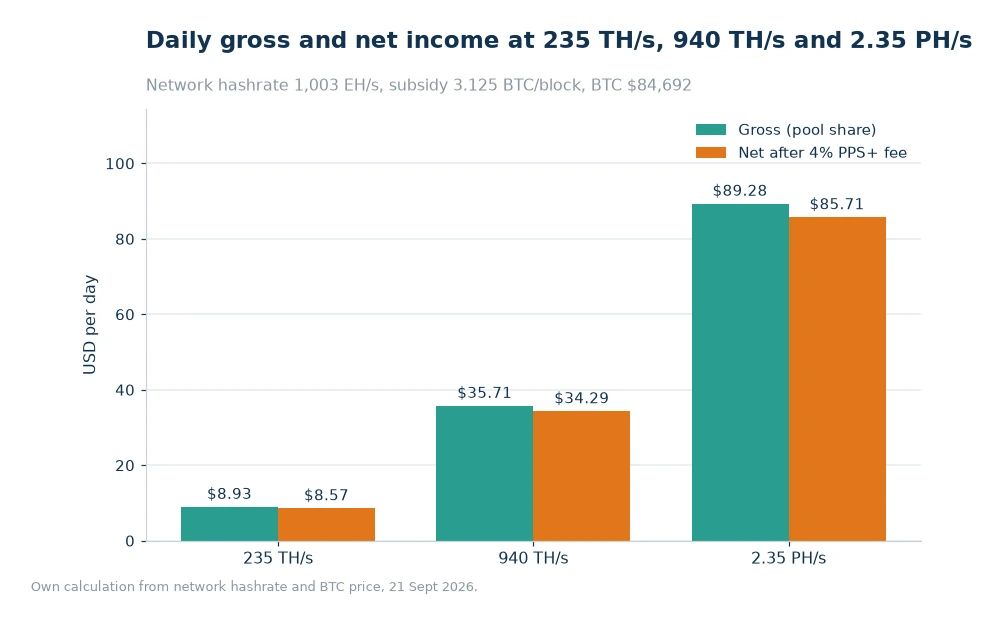
Translate a sale into mining time with the three hashrates in the chart, all read from the same network inputs.
- One terahash produces 0.00000044865 BTC a day, since 450 BTC is shared across 1.003 billion TH/s.
- At 235 TH/s: 235 × 0.00000044865 = 0.00010542 BTC a day, or $8.93 at $84,692.
- Net after the listed 4%: 8.93 × 0.96 = $8.57 a day, which is $0.36 an hour.
- 940 TH/s, four machines at 235 TH/s: 0.00042169 BTC, $35.71 gross and $34.29 net a day.
- 2.35 PH/s, ten machines: 0.00105422 BTC, $89.28 gross and $85.71 net.
- A $500 invoice is therefore 500 ÷ 0.36 = about 1,400 hours of 235 TH/s credit, or 58 days of continuous mining.
Frequently asked questions
Should a shop accept a payment with no confirmations?
For small invoices it is a reasonable trade, because the exposure is below the cost of managing the wait; for large ones a confirmation or two is the safer default.
Can the shop accelerate a customer's payment?
Yes, if it has the transaction hash. The service accepts BTC, BCH or LTC for the paid route, and the submission cannot be reversed once sent.
What if the customer paid from many small coins?
The transfer may exceed the 0.5 KB size limit for the free queue even at an acceptable fee rate, in which case only the paid route remains.
Write the policy, then relax
Put the confirmation thresholds on the invoice template and in the checkout notes. Decide who pays for a hurry before a hurry happens. Train one person on the tool and give them the bookmark. With those three things done, a slow payment becomes an ordinary operational event rather than a crisis at the counter.
For the mechanics, the documentation explains the size and fee tests, and submissions are accepted around the clock. Hold the proceeds in the multi-currency wallet if you also mine, so shop income and mining credit sit in one balance, and check the listed rates before assuming what a settlement costs.
Sources: ViaBTC's accelerator documentation and fee page[1]. Read 21 Sept 2026: 1,003 EH/s network hashrate, 132.76 T difficulty, 3.125 BTC per block, 144 blocks a day, BTC $84,692. Published 24 Oct 2026; confirmation tiers are an example policy.